


It’s time to look back on 2024! Check our blog between Christmas and New Year’s for a variety of stories and memories of 2024 from the staff and volunteers of the Wildlife Center of Virginia.
This year, like every year, was full of many memorable patients. However, this year stood out for the number of interesting avian cases we received, with my absolute favorite arriving on March 24th. This day was a relatively calm Sunday, like many others I had worked before. I had been working with students to admit a handful of birds that arrived throughout the day when I received a message from our previous veterinary intern, Dr. Natalie Brown, about a Great Blue Heron patient (#24-0361) she had captured and was transporting to the Center. She warned me of the gravity of the heron’s injury when she arrived, and I was anticipating a very short stay for this individual. The vast majority of herons that present to us here in the mountains arrive with grave, chronic injuries that cannot be treated, and I expected this patient to be no different.
I gave the students instructions on how to handle a heron patient and allowed them to perform the admission examination as we typically do. When they presented the case to me, I had a glimmer of hope, as the injury sounded like something I could possibly fix. I performed my examination and found the heron to be in excellent overall condition, but with a fracture of the right metacarpus, the bones near the tip of a bird’s wing. I had repaired metacarpal fractures before but had never treated a Great Blue Heron for any extensive injuries. Admission radiographs confirmed that the fracture was an excellent surgical candidate, but I had significant concerns as herons can be extremely challenging to care for in captivity. These large, elegant birds are particularly sensitive to stress, which can exacerbate injuries and hinder recovery.
Upon making the decision to treat the heron, I immediately implemented strict rules surrounding its care. I created several bright neon pink signs to hang around the clinic, clearly marking the bird’s area and serving as constant reminders to all staff and students to remain silent and as still as possible near this patient. We understood that even the slightest noise or movement could cause undue stress, so creating a calm, quiet environment was paramount. Every day, I stressed the importance of keeping the space as serene as possible for the heron’s recovery before we even began treatments.
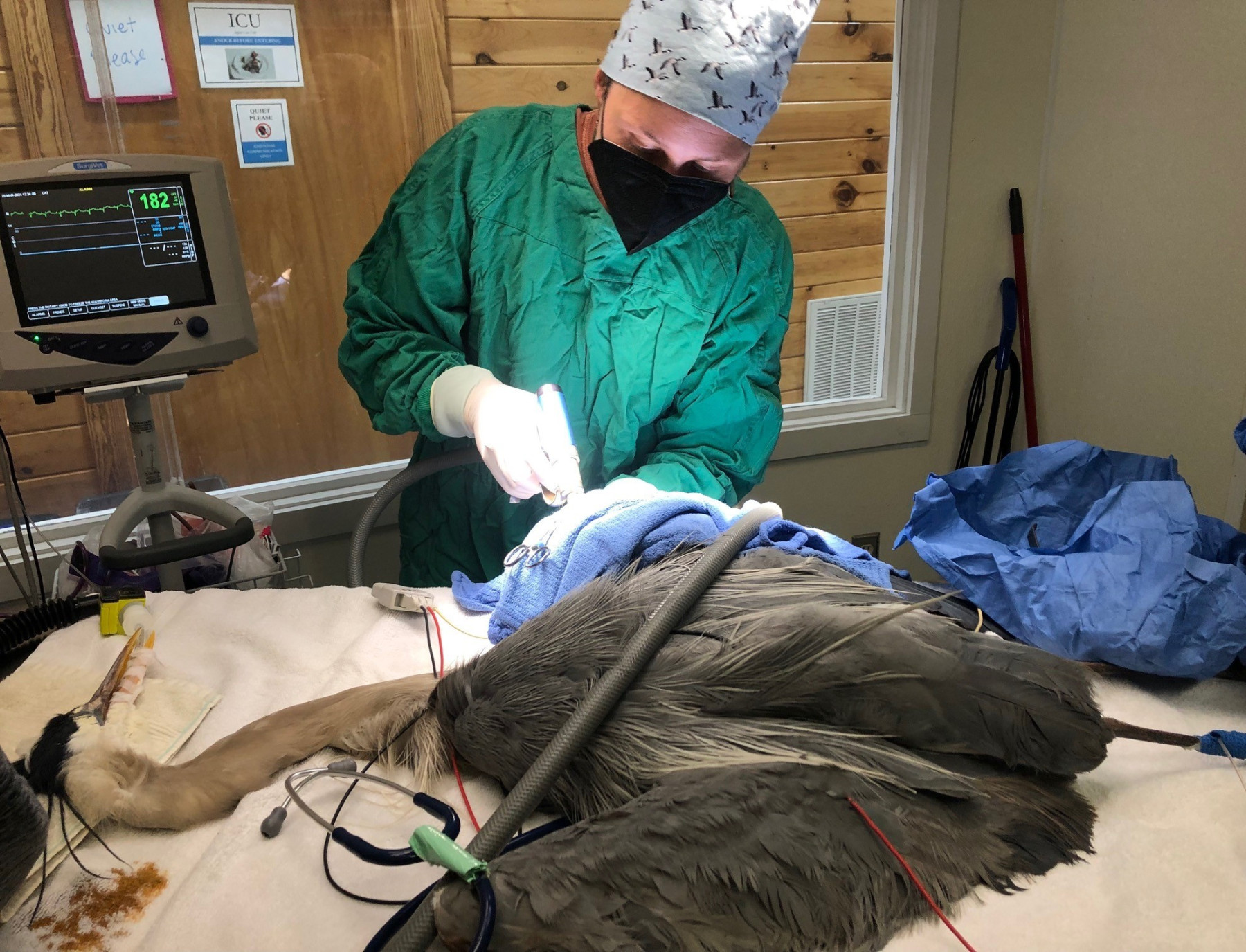
On the afternoon of March 25, our veterinary technician intern, Jenn, and I performed the surgery. It was my first time performing surgery on a Great Blue Heron, and the weight of responsibility felt significant. I used a surgical drill to insert a total of five small metal pins directly into the bone, both above and below the fracture site, to stabilize the bone fragments. Once the pins were in place, we took radiographs to confirm their proper placement. I used an acrylic bar to connect the pins, creating a stable, immobilized framework to hold the fractured bone in position as it healed. The surgery was successful, and the heron was placed back in its crate to recover under close observation.
In the days following the surgery, our focus shifted to the heron’s recovery. One of the most challenging aspects of the heron’s care was encouraging it to eat on its own. Fish-eaters like herons are often reluctant to eat when stressed or in captivity, and this heron was no different. Unlike many of our other patients, this bird required a much more hands-off approach. To facilitate its recovery and encourage eating, we decided to move the heron from the crate to an outdoor enclosure much earlier than we typically would for an orthopedic injury. This decision was made with great care, considering the heron’s need for space and its natural behaviors.
We set up the enclosure to mimic the heron’s natural environment as closely as possible. This meant incorporating a pool with access to fresh water and providing live fish to entice the heron to feed. In the wild, Great Blue Herons hunt for fish, so offering fish in the enclosure was designed to encourage the heron to engage in natural foraging behaviors. The goal was to minimize our interactions with the bird, reducing stress by allowing it to feel as comfortable as possible in its surroundings.
While the heron was in the enclosure, we took a largely hands-off approach. We only intervened when absolutely necessary, performing recheck examinations and radiographs once per week to monitor the healing progress. Our technician Jess and I performed every weekly recheck exam, and by the end, this heron had stayed with us for so long that it became routine. This minimal handling approach worked very well for the heron, and we were able to see continuous progress in its healing.
In August, after the 19th set of follow-up radiographs since the heron’s March surgery, I felt that the heron was fully healed and ready for flight testing. This was a nerve-wracking moment for everyone involved—not just because of the high-stress nature of the flight test itself, but because we were all holding our breath to see if the surgery and treatment had been successful. The flight test was a crucial step in determining whether the heron could fly unimpeded and return to the wild. We moved it to one of the Center’s 100-foot-long flight enclosures and with the team watching anxiously, I released the heron at one end of the enclosure, holding my breath as it took flight. The heron flew the entire length of the flight pen without hesitation—a moment of pure relief and triumph.
After 143 days of stress and hope for this patient, the heron was released back into its natural habitat. Watching the bird take off after months of careful treatment and rehabilitation was a deeply rewarding moment for me and the entire team. It felt like a true testament to the hard work, dedication, and care that went into this bird's recovery.
Looking back, this year’s experiences have been an incredible reminder of why we do what we do. Each patient that comes through our doors is a unique challenge, and no two cases are ever the same. This case reminded me of the importance of ongoing learning and the satisfaction that comes with overcoming challenges, especially when it comes to wildlife rehabilitation. With each challenge, there is a reward—both in the success of the animal’s recovery and in the growth we experience as caregivers and professionals. The Great Blue Heron’s story is just one example of the many triumphs we’ve celebrated this year, and I am deeply grateful to be part of a team that continuously strives to give every wild patient a second chance at life.
— Olivia Schiermeyer, Veterinary Research Fellow