


It’s time to look back on 2025! Check our blog between Christmas and New Year’s for a variety of stories and memories of 2025 from the staff of the Wildlife Center of Virginia.
As expected, 2025 was one of the most life-changing years I have experienced. I had graduated in April, and as a licensed veterinary technician, I was no longer watching and learning from the sidelines. After years of staring in awe as our team performed life-saving surgeries, now I was the one keeping the patient alive under anesthesia. Those cell types and diagnostics I had spent the last two years memorizing—now I was the one performing them. I had practiced on blood draws and IV catheter placement on dummies and models, and suddenly, they were no longer silicone and plastic. They were real, live patients whose entire well-being relied on us. Despite learning so many new things about wildlife medicine in the past year, in-the-field rescues have—and will probably always be—my favorite part of wildlife rehabilitation. And the best part is that this was the first year when my mom and I truly became rescue partners.
Eastern Ratsnake #25-0864 will always be on the record board for me. My mom and I had rescued her in Fluvanna County back in April. To add some important context, my mom and I had already performed several rescues this year. In the last couple of years, my mom, Jessica, has discovered a passion for wildlife rescue, and she has quickly become one of our most traveled volunteer transporters. With hundreds of hours and miles spent on the road, one of our fellow volunteer rescuers quotes, “Seventy-five percent of the world is covered by water, and the rest is handled by Jessica.” While the Center is usually unable to spare resources to send staff into the field, my weekends this year were usually spent on the other side of the state, joining my mom in a chase after some injured animal. I’ve quickly adopted the same problem as her when it comes to rescue requests—a difficulty saying no.
Partially flighted, fishline-entrapped goose? Sure, we’ll try. We will jump into a feces-filled pond after it.
Black Vulture, who spent months grounded in a neighborhood? Yeah, we will be there in an hour.
Turtles with crushed shells located two hours from home. Hawks with open, infected fractures. We’ve kayaked around a state park, because someone reported an injured gosling. We even spent the first few weeks of 2025 waist-deep in a freezing-over pond trying to catch an injured cormorant.
Tough rescues usually carry a low chance of success and an even lower chance of release. Ratsnake #25-0864 was certainly not our easiest. My mom had reached out on my day off, asking if I was interested in riding down to Fluvanna County in search of a ratsnake with suspected snake fungal disease.
“How far from me?” I sighed. I had just gotten home from an hour-long vet appointment, and it was my weekend. I was tired.
“About an hour. Just sent you the photos,” she replied. My phone opened to an image of a large Eastern Ratsnake coiled in a log. Her face and the visible portions of her body were covered in crusted, necrotic yellow lesions. Large flakes of stuck shed were crusted to her nose, and her eye caps were opaque.
“Yeah, I’ll meet you there.” This snake looked terrible, and the idea of her spending another night in that condition made me sick to my stomach. Snake Fungal Disease, or SFD, is a relatively new disease caused by the primary pathogenic fungus, Ophidiomyces ophiodiicola. The fungus invades the skin, causing crusted, necrotic lesions, especially around the face and mouth. A rise in cases has been reported in the last few decades, likely due to climate change and habitat degeneration, leading to stress in local populations. Stress compromises the snake’s immune system, leaving room for an opportunistic pathogen like Ophidiomyces to take hold. The fungus has caused dramatic population declines in certain species, and we see numerous cases at the Wildlife Center every year.
What mattered to me most, though, was that this disease was treatable. This was our first rescue in a while where the chances of recovery and release weren’t immediately negligible.
That fishing line–entrapped goose? The fishing line left the limb necrotic and unsalvageable. The Black Vulture evaded our capture. We never found the gosling (my partner had joined us and even elected to sacrifice his phone and wallet to search under his kayak. What a gentleman.) And the cormorant was found deceased, frozen to the ice on the morning of our final rescue attempt.
We were running a streak of disappointing outcomes. And though I fully believe humane euthanasia is a successful outcome for a suffering patient, we were struggling to even capture these patients, let alone get them into care for appropriate treatment. As I got closer to the rescue location, I was already expecting the worst for #25-0864. No one had laid eyes on her in hours. Thankfully, her finder, a kind woman named Kirsten, who regularly hiked this nature area, was willing to meet us and lead us directly to this snake’s favorite hiding spot: a fallen tree. Kirsten had seen her regularly for the last couple of weeks and had noticed her symptoms seemed to be worsening.
When we arrived, Kirsten led us on a beautiful half-mile hike through the forest. On the way, we traded stories of spectacular wildlife encounters, rescues, and more about the field of rehabilitation. Kirsten may have thought of us as a bit weird, but she seemed to share our same fondness for all things scaly. When we reached the fallen logs, I nearly jumped with joy: two bright white eyes and a crusted dark nose greeted us. Unfortunately, this snake was not interested in our unexpected visit. Our first capture attempt missed, and she disappeared deeper into the log. We began tearing away large strips of bark, searching for a glimpse of her scaly body. After several minutes, a snake pole and a hatchet joined the effort. It felt a little rude—I hadn’t planned on breaking and entering that day—but eventually my mom managed to grab a portion of her tail and pull her free. We slipped her into a pillowcase as she voiced her opinions with a very defensive hiss.
“She doesn’t look good,” I remember my mom saying.
“No, I really think we can fix this one.” I can’t describe the pride I felt, finally being able to say those words.
It took two months of supportive care, lots of wound management, and a slow-release antifungal implant under the skin to fully treat #25-0864. Her necrotic wounds took time to fully heal, and her condition had left her with a retained eye spectacle that required multiple sheds to fully remove.
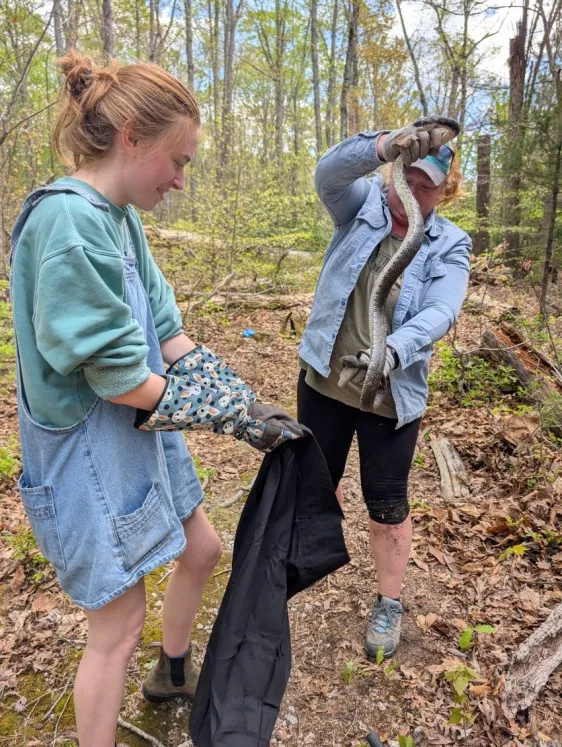
In June, almost exactly two months after our rescue, with shiny scales and clear eyes, Eastern Ratsnake #25-0864 returned home.
This case seems small, but it was huge for me. One of the biggest lessons I learned this year was that wildlife rescue is difficult, emotionally and physically. Four years ago, in my first year-end memory, I described the work we do as close to miracles. I feel differently now. Miracles sound easy, magical even, and while our ability to get these animals home is miraculous, the amount of experience, knowledge, and resources that go into these patients is anything but effortless. These stories are a testament to the quiet labor that no one outside the field ever sees. It’s not magic; it’s persistence, teamwork, sacrifice, and a willingness to learn from every case, even when carrying the heartbreak of others. It helps when you have folks who understand the burden, especially ones so close to home.
Thanks, Mom. Here’s to many more feces-filled ponds, cold morning rescues, and the lives we get to save together.
– Lilly Farmer, Veterinary Technician Intern